 Image 1 of 1
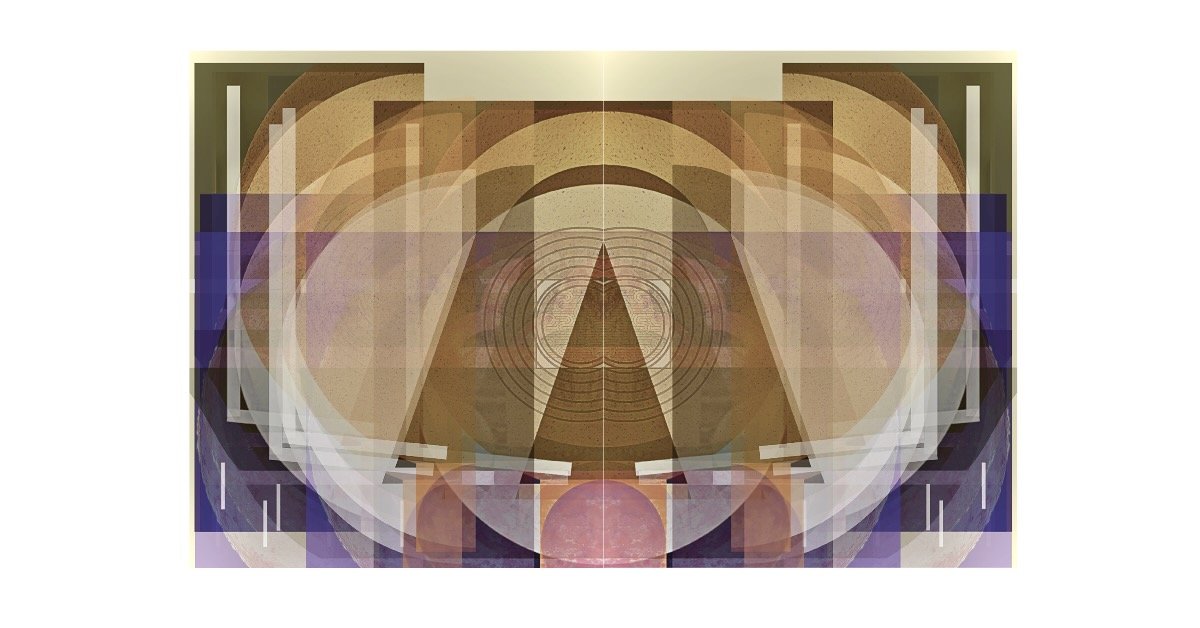
A symmetrical, architectural composition radiating from a central point of convergence, Temple of the Aether Lens evokes the feeling of stepping into an interdimensional observatory or sacred computational chamber. A glowing triangular prism anchors the center, flanked by nested arches and expanding concentric rings—suggestive of both optical lenses and temple domes. The geometry calls forth a spiritual-mechanical hybrid, where sacred space meets advanced data visualization.
Amber, sand, and violet tones build a feeling of warmth and transcendence. Rectilinear bars float like calibration lines or glyphs from a forgotten codebase, framing the forms like scaffolding. At the base, a glowing orb or portal sits embedded within architectural columns—an eye, a gateway, or an encoded sun.
This piece exudes clarity, alignment, and insight. While its symmetry provides balance and grounding, the layered transparencies hint at multiple planes of reality coexisting—a meditation on perception itself.
This is a place of reception. The “aether lens” is symbolic of inner seeing, divine perspective, or deep cosmic data streaming. It could be read as a spiritual device—one that filters noise from signal, or allows the soul to glimpse universal truths. It feels like the mental architecture behind intuitive knowing, dream decoding, or quantum meditation.
Axis of Illumination is a contemplative exploration of balance, geometry, and the architecture of consciousness. Composed of intersecting circles, translucent planes, and ascending forms, the work radiates from a central axis that draws the eye toward a luminous triangular gateway. The composition evokes the precision of sacred geometry while maintaining the openness of abstraction, inviting viewers to discover their own symbolic meanings within its layered structure.
Warm earth tones of ochre, bronze, and sandstone are softened by translucent whites and deep indigos, creating a harmonious dialogue between stability and mystery. Concentric circles ripple outward from the central triangle like waves of thought or expanding awareness, suggesting the unfolding of insight from a single point of origin. Each overlapping form contributes to a visual rhythm that feels both architectural and meditative.
The image suggests a place of passage—a threshold where intellect meets intuition and form dissolves into light. The triangle, often associated with aspiration and transformation, rises through the heart of the composition as a symbol of inner awakening, while the surrounding circles represent cycles, unity, and the infinite nature of existence. Axis of Illumination invites quiet reflection, encouraging viewers to consider the invisible structures that shape perception, memory, and the continual search for meaning.
A symmetrical, architectural composition radiating from a central point of convergence, Temple of the Aether Lens evokes the feeling of stepping into an interdimensional observatory or sacred computational chamber. A glowing triangular prism anchors the center, flanked by nested arches and expanding concentric rings—suggestive of both optical lenses and temple domes. The geometry calls forth a spiritual-mechanical hybrid, where sacred space meets advanced data visualization.
Amber, sand, and violet tones build a feeling of warmth and transcendence. Rectilinear bars float like calibration lines or glyphs from a forgotten codebase, framing the forms like scaffolding. At the base, a glowing orb or portal sits embedded within architectural columns—an eye, a gateway, or an encoded sun.
This piece exudes clarity, alignment, and insight. While its symmetry provides balance and grounding, the layered transparencies hint at multiple planes of reality coexisting—a meditation on perception itself.
This is a place of reception. The “aether lens” is symbolic of inner seeing, divine perspective, or deep cosmic data streaming. It could be read as a spiritual device—one that filters noise from signal, or allows the soul to glimpse universal truths. It feels like the mental architecture behind intuitive knowing, dream decoding, or quantum meditation.
Axis of Illumination is a contemplative exploration of balance, geometry, and the architecture of consciousness. Composed of intersecting circles, translucent planes, and ascending forms, the work radiates from a central axis that draws the eye toward a luminous triangular gateway. The composition evokes the precision of sacred geometry while maintaining the openness of abstraction, inviting viewers to discover their own symbolic meanings within its layered structure.
Warm earth tones of ochre, bronze, and sandstone are softened by translucent whites and deep indigos, creating a harmonious dialogue between stability and mystery. Concentric circles ripple outward from the central triangle like waves of thought or expanding awareness, suggesting the unfolding of insight from a single point of origin. Each overlapping form contributes to a visual rhythm that feels both architectural and meditative.
The image suggests a place of passage—a threshold where intellect meets intuition and form dissolves into light. The triangle, often associated with aspiration and transformation, rises through the heart of the composition as a symbol of inner awakening, while the surrounding circles represent cycles, unity, and the infinite nature of existence. Axis of Illumination invites quiet reflection, encouraging viewers to consider the invisible structures that shape perception, memory, and the continual search for meaning.